
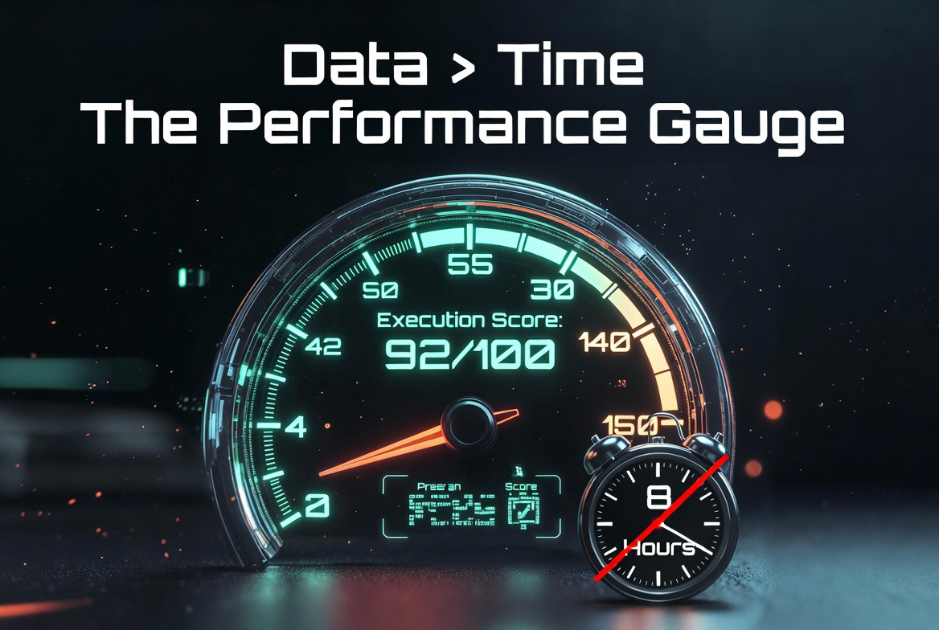
Beyond the Clock: Why the Execution Score is the Only Metric That Matters
The Vanity of "Hours Worked"
We have been conditioned to believe that "working 8 hours" is a sign of productivity. In the era of the knowledge worker and the solo builder, this is a lie. You can sit at a desk for 10 hours and achieve nothing of value. Conversely, a single hour of "Hyper-Focus" can move a project forward more than a week of shallow work.
If you want to hit the Top 3 in your niche, you have to stop measuring input and start measuring Execution Quality. At KAMYAAB AI, we do this through the Execution Score.
What is an Execution Score?
The Execution Score is a multi-dimensional metric that calculates your "Output Velocity" based on three distinct data points:
1. Plan-Lock Rate: How often do you actually do what you said you would do?
2. Deterministic Speed: How close were your estimates to your actual execution time?
3. Consistency Floor: What is the minimum level of output you maintain even on your "bad" days?
By combining these, KAMYAAB AI creates a real-time health check for your project. If your score is high, you are on a Success Trajectory. If it’s low, the system identifies exactly where the leak is: is it a lack of focus, or are you over-complicating the plan?
The Fallacy of the "Busy" Founder
Solopreneurs often wear "business" as a badge of honor. But business is often just a lack of Execution Intelligence.
When you track your day via the KAMYAAB Timer, you aren't just logging time; you are generating "Signal." The system looks for "Dead Time"—those gaps between tasks where decision fatigue sets in. By narrowing these gaps, your Execution Score rises, and your "Time-to-Market" shrinks.
Data-Driven Recalibration
The most powerful feature of the Execution Score is its ability to predict the future. If you have an Execution Score of 85 over three weeks, KAMYAAB AI can mathematically predict your launch date with 95\% accuracy.
This removes the anxiety of the "Unknown." You no longer have to hope you finish on time; you have the data to know you will. And if the data shows you are slipping, the system prompts a Trajectory Adjustment before the delay becomes a disaster.
Conclusion: Engineering Your Output
You cannot manage what you do not measure. But if you measure the wrong things, you will optimize for the wrong results. Stop tracking hours. Start tracking your Execution Score.
Focus on the score. The results will follow.